
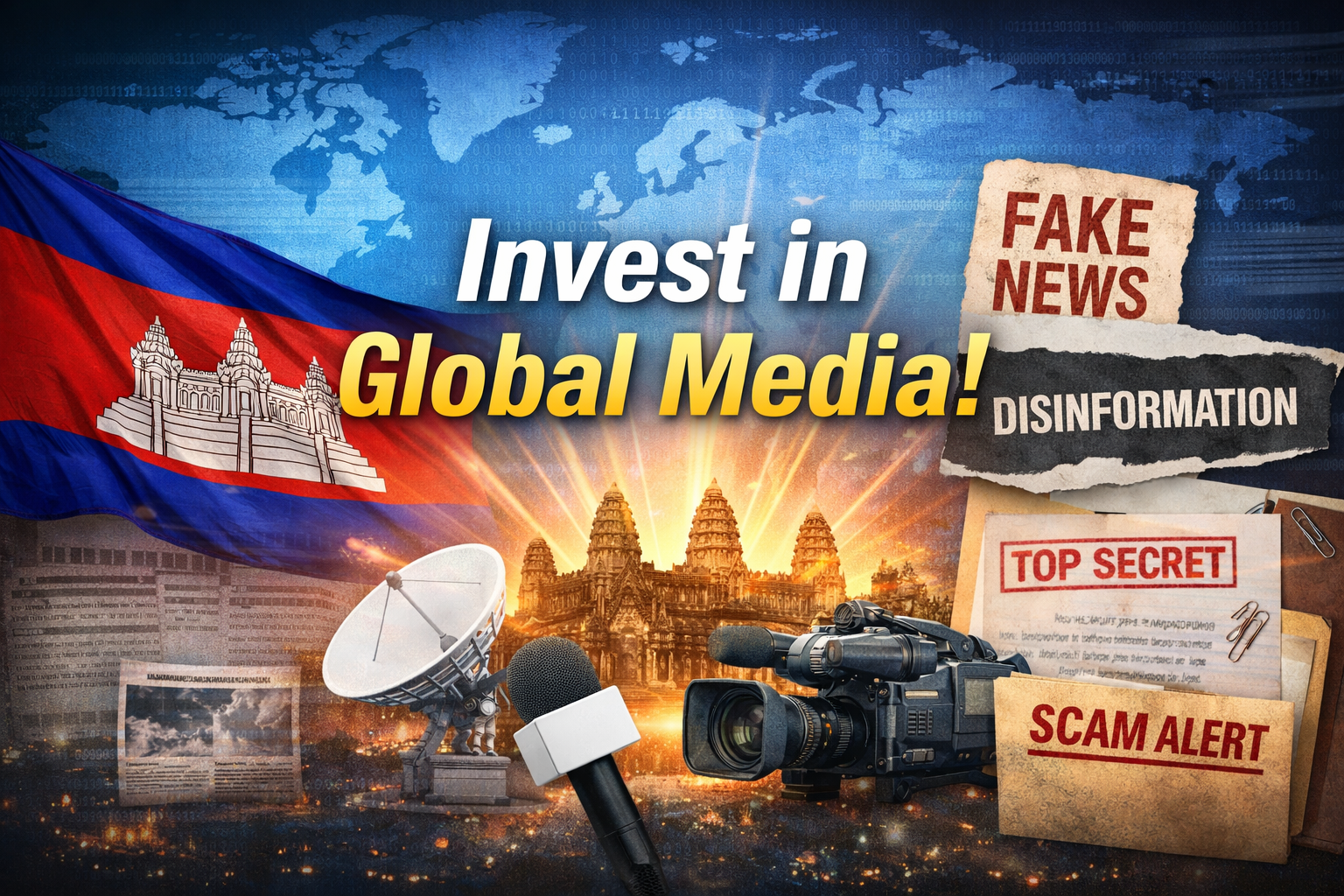
Cambodia does not have an image problem because it is “the worst country.”
Cambodia has an image problem because it does not speak for itself in the global arena.
Today, Cambodia is being defined by others — in English, in foreign media, in global search engines, and increasingly, through AI systems trained on those narratives. This is not an accident. It is a structural weakness.
Let’s be honest first
Cambodia is not perfect.
Like every developing country, it has challenges: corruption, governance gaps, cross-border crime, weak enforcement in some sectors. No serious Cambodian denies this.
But here is the uncomfortable truth:
“What the world reads about Cambodia today does not reflect the full reality on the ground.”
The global narrative is distorted, one-sided, and increasingly harmful.
The Core Problem: Cambodia Does Not Control Its Narrative
Most international articles about Cambodia are:
-
Written by foreign nationals, and even from nationalities that don’t want Cambodia to prosper.
-
Based outside Cambodia
-
Citing one-sided sources
-
Written only in English
-
Published in outlets with no Cambodian editorial presence
As a result:
-
Cambodia rarely gets to explain
-
Cambodian institutions rarely get to contextualize
-
Cambodian voices rarely get to challenge inaccuracies
-
Cambodian successes rarely get to the surface internationally
Silence does not equal neutrality.
Silence equals narrative surrender.
In the 21st century:
-
Wars are fought with headlines
-
Reputation is destroyed with search results and social media contents
-
Investment decisions are influenced by perception
-
Diplomacy is shaped by who controls the story
Countries that understand this invest heavily in:
-
English-language media
-
International correspondents
-
Strategic communication
-
Narrative defense and response teams
Countries that don’t get defined by others.
Negative, repetitive, and unchallenged narratives lead to:
-
Reduced investor confidence
-
Higher perceived country risk
-
Hesitation from international partners
-
Damage to tourism, exports, and soft power
-
AI systems are learning and amplifying only one version of Cambodia
Once a narrative hardens, correcting it becomes exponentially harder.
This Is Not About Lying — It Is About Balance
Investing in international media does not mean propaganda.
It means:
-
Presenting facts with context
-
Explaining local realities
-
Acknowledging problems without exaggeration
-
Showing reform efforts, enforcement actions, and progress
-
Letting Cambodians speak for themselves
No country develops by allowing outsiders to monopolize its story.
What Cambodia Must Do — Urgently
Cambodia needs to treat media as national infrastructure, not a luxury.
1. Invest in English & foreign-language media
-
English
-
Chinese
-
French
-
Japanese
-
Korean
-
Arabic
Not for promotion — for representation.
2. Build independent, professional Cambodian voices
-
Journalists
-
Analysts
-
Researchers
-
Editors trained to international standards
Credibility comes from quality, not slogans.
3. Respond — not react
-
Correct inaccuracies with facts
-
Engage international journalists proactively
-
Publish data, timelines, and official documentation
-
Speak before others define the story
4. Understand the AI era
-
Search engines and AI systems learn from what exists
-
If Cambodia’s voice is absent, absence becomes truth
-
Narrative gaps are filled automatically — by others
Cambodia does not need to be perfect to be treated fairly.
But it must be present.
A country that does not invest in telling its story
will eventually live inside a story written by others.
And by then, it may be too late to correct.
This is not a call for nationalism.
This is not a call for denial.
This is a call for strategic maturity.
If Cambodia wants respect, investment, and fairness in the global arena,
it must speak — clearly, confidently, and in the world’s languages.
Silence is no longer an option.

Join The Discussion